

Software Defined Storage Market to Grow at a 23.3% CAGR, Reaching USD 171.35 Billion by 2035
Software Defined Storage Market
Software-Defined Storage Market Research Report Information By Components (Platforms and Services), Application (Telecom and ITES, Logistics and Warehouse
Software Defined Storage Market is growing as organizations seek flexible, scalable, and cost-efficient data storage solutions for modern IT environments.”
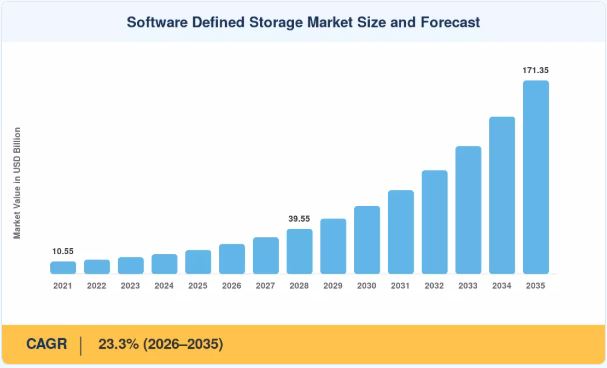
NEW YORK,, NY, UNITED STATES, August 7, 2026 /EINPresswire.com/ -- The Global Software Defined Storage market stood at an estimated USD 21.10 billion in 2025 and is projected to open the forecast window at roughly USD 26.02 billion in 2026, climbing to USD 171.35 billion by 2035 at a CAGR of 23.3%. Two forces anchor this trajectory: explosive unstructured data growth from AI training pipelines and video and sensor telemetry that legacy hardware-defined arrays were never architected to absorb, and the shift toward hybrid and multi-cloud IT estates where enterprises need a single, consistent data-services layer spanning on-premises infrastructure and multiple public clouds. — Market Research Future (MRFR)
The market's 23.3% CAGR reflects the convergence of explosive unstructured data growth (~22% CAGR impact), hybrid and multi-cloud adoption (~20%), Kubernetes and container orchestration (~18%), cost advantage over legacy SAN/NAS (~15%), AI/ML data pipeline requirements (~12%), edge computing and IoT proliferation (~8%), and data sovereignty and compliance mandates (~5%) accelerating across the world's largest enterprise IT markets simultaneously.
Legacy proprietary SAN and NAS appliances are increasingly being replaced by software layers that abstract storage intelligence from the physical disks beneath them, allowing storage pools to scale by adding commodity hardware rather than forklift upgrades. Investment in Kubernetes-native persistent storage is increasingly focused on CSI driver integration over bolt-on volume plugins, reducing operational overhead and total cost of ownership. North America dominates the market with an estimated 38% share, supported by early enterprise adoption and a mature cloud ecosystem.
Asia-Pacific is the fastest-expanding region at a 27.4% CAGR, fueled by data center construction in India, China, and Southeast Asia. Not far behind is Europe, with GDPR-related data management requirements and sovereign cloud investments across the continent. Software-defined storage is becoming a fundamental infrastructure requirement rather than a discretionary IT upgrade as unstructured data volumes and multi-cloud complexity intensify.
Get Full PDF Sample Copy of Report: (Including Full TOC, List of Tables & Figures, Chart) @
https://www.marketresearchfuture.com/sample_request/1958
➤ How Significant Is the Software Defined Storage Market's Growth?
The software defined storage market's trajectory from USD 21.10 billion in 2025 to a projected USD 171.35 billion by 2035 represents more than an eight-fold expansion over the forecast decade, reflecting the structural shift across global enterprise IT from proprietary hardware-based storage arrays toward programmable, hardware-agnostic architectures as a baseline infrastructure standard. The market's 23.3% CAGR is anchored in a storage-modernization supercycle where hyperscale cloud providers, regulated industries, and container-native enterprises are all specifying software-defined platforms as non-negotiable infrastructure rather than an optional upgrade.
Block storage holds the largest 2025 revenue share at approximately 35%, anchoring mission-critical databases and transactional systems, while Object storage is the fastest-growing storage type at a 26.8% CAGR through 2035, driven by unstructured data from AI training pipelines and media workloads. File storage is valued at USD 5.07 billion in 2025, serving enterprise file services and NAS replacement.
By deployment mode, On-Premises holds the largest share at approximately 44% among regulated industries requiring local control, while Private Cloud is the fastest-growing deployment mode at a 25.9% CAGR as enterprises seek cloud-like agility within their own data centers. By organization size, Large Enterprises account for roughly 62% of 2025 revenue, while Small and Medium Enterprises are growing fastest at a 26.5% CAGR as managed SDS offerings lower the entry barrier. By end-user, Telecom and IT represents approximately 28% of total market revenue, while BFSI is among the fastest-growing verticals at a 25.2% CAGR.
➤ What Does the Future Hold for the Software Defined Storage Market?
Explosive unstructured data growth contributes approximately 22% of the software defined storage market's CAGR the single highest driver impact. Global data creation is expected to exceed 180 zettabytes annually by 2026, with unstructured data comprising over 80% of that volume, and traditional hardware-defined arrays were never architected for this scale. Software-defined storage platforms can scale storage pools by adding commodity hardware without forklift upgrades, reducing cost-per-terabyte by 40–60% compared to monolithic arrays.
Hybrid and multi-cloud adoption contributes approximately 20% to the CAGR, as 89% of enterprises now operate in multi-cloud environments yet only 34% have a unified storage management layer across those clouds a gap that is a primary purchase trigger for the market. Kubernetes and container orchestration contribute a further 18%, as the Cloud Native Computing Foundation reported over 5.6 million Kubernetes developers globally by mid-2024, a 67% increase from 2022, making container-native storage through CSI drivers table stakes for enterprise deployments. The cost advantage over legacy infrastructure remains compelling at the CFO level: enterprises spend an average of USD 3,200 per terabyte annually on traditional SAN, compared to USD 800–1,400 per terabyte on SDS-managed commodity storage for a mid-sized bank managing 5 petabytes, this translates to annual savings of USD 9–12 million.
The next product generation is shifting from manually provisioned volumes to AI-driven autonomous storage management, with machine learning algorithms forecasting disk failures 72 hours in advance and auto-tiering data based on access patterns to decrease storage management effort by up to 60%. Vendors are increasingly competing on platform economics storage marketplaces where third-party data services such as encryption, deduplication, and analytics plug into a shared storage substrate rather than software licensing alone, a model already visible in VMware's vSAN ecosystem and Red Hat's ODF marketplace that could generate 25–30% of vendor revenues by 2033. By 2030, 60% of enterprise storage environments are expected to be managed through AI-driven automation, up from just 15% in 2024, transforming storage administrators from operators into policy architects.
Get access to the full description of the report @
https://www.marketresearchfuture.com/reports/software-defined-storage-market-1958
➤ Who Are the Key Players in the Software Defined Storage Market?
The software defined storage market exhibits medium concentration, with the top five vendors holding an estimated 45–52% combined revenue share and a Herfindahl-Hirschman Index in the 600–900 range a competitive but not fragmented landscape where competition centers on integration depth with hypervisor platforms, Kubernetes-native capabilities, and consumption-based pricing models. MRFR identifies the following key participants with estimated revenue share ranges:
★ Dell Technologies (~12–15% share) – a full-stack infrastructure leader providing PowerFlex, ObjectScale, and ECS platforms with deep hyperconverged infrastructure integration.
★ IBM Corporation (~9–12% share) – an enterprise hybrid cloud specialist providing Spectrum Virtualize and Fusion HCI platforms embedded with AI Ops capabilities.
★ VMware (Broadcom) (~8–11% share) – a hypervisor-native SDS provider offering vSAN and vSphere Virtual Volumes for virtualized enterprise estates, having restructured vSAN licensing under the VMware Cloud Foundation bundle in April 2024.
★ NetApp (~7–10% share) – a unified hybrid multi-cloud data management provider offering ONTAP, StorageGRID, and BlueXP, having expanded BlueXP in August 2024 with integrated ransomware detection and autonomous remediation across ONTAP-managed volumes.
★ Hewlett Packard Enterprise (~6–9% share) – a consumption-based as-a-service leader offering Alletra and GreenLake for Storage, having expanded GreenLake for Block Storage with NVMe-oF support in November 2023 to achieve sub-100-microsecond latency.
★ Microsoft (~5–8% share) – a cloud-adjacent SDS provider offering Azure Stack HCI and Storage Spaces Direct for Azure-centric enterprise estates.
★ Nutanix (~4–7% share) – a hyperconverged-first specialist offering Nutanix Unified Storage and AOS with multi-cloud portability designed for remote edge locations.
★ Pure Storage (~3–6% share) – a Kubernetes-native specialist offering Portworx and Pure Cloud Block Store under an Evergreen subscription model.
★ DataCore Software (~2–4% share) – a software-only virtualization provider offering SANsymphony, vFilO, and Swarm across heterogeneous hardware environments.
★ Red Hat (IBM) (~2–4% share) – an open-source SDS provider offering OpenShift Data Foundation and Ceph purpose-built for container-native environments.
★ Strategic competition in the software defined storage market is increasingly defined by Kubernetes-native capability and consumption-based pricing flexibility, with vendor lock-in risk and cross-vendor interoperability cited as top procurement concerns alongside NVMe-oF latency performance, data sovereignty policy engines, and the depth of AI-driven autonomous management that converts one-time software licenses into recurring platform revenue.
➤ What Are the Emerging Trends in the Software Defined Storage Market?
Several transformational trends are redefining the software defined storage market's evolution through 2035:
Explosive Unstructured Data Growth Driving Object Storage Adoption: Global data creation is expected to exceed 180 zettabytes annually by 2026, with unstructured data comprising over 80% of that volume. This has made object storage architectures the default choice for petabyte-scale deployments where cost efficiency outweighs latency requirements.
Hybrid and Multi-Cloud Adoption Demanding Unified Data Services: With 89% of enterprises operating in multi-cloud environments but only 34% having a unified storage management layer, enterprises are prioritizing SDS platforms that deliver consistent snapshots, replication, and tiering whether data resides on-premises or across AWS, Azure, or GCP.
Kubernetes and Container Orchestration Becoming Table Stakes: Container-native storage through CSI drivers has become a baseline requirement, with vendors like Red Hat's OpenShift Data Foundation and Pure Storage's Portworx embedding persistent volume management directly into orchestration platforms.
AI-Driven Autonomous Storage Management Gaining Adoption: Machine learning algorithms can now forecast disk failures 72 hours in advance and auto-tier data based on access patterns, decreasing storage management effort by up to 60% and freeing IT teams to focus on application-level innovation.
Storage-as-a-Service and Consumption-Based Models Expanding: Enterprises are increasingly paying for storage on a per-terabyte-consumed basis through offerings like HPE GreenLake, Dell APEX, and NetApp Keystone, a shift that could constitute 35% of the market by 2030.
Sovereign Cloud and Data Residency Compliance Requirements Rising: The EU Data Act and India's DPDP Act create legal mandates for in-country data storage, positioning SDS platforms that offer policy-driven storage management across distributed nodes to address these requirements without duplicating entire infrastructure stacks.
Buy Full Research Report:
https://www.marketresearchfuture.com/checkout?currency=one_user-USD&report_id=1958
➤ How Is the Software Defined Storage Market Segmented?
The software defined storage market report provides a comprehensive segmentation framework:
By Storage Type: Block (largest, ~35% share, 2025), Object (fastest-growing, 26.8% CAGR), File (USD 5.07B, 2025), Others (19.5% CAGR)
By Deployment Mode: On-Premises (largest, ~44% share, 2025), Private Cloud (fastest-growing, 25.9% CAGR), Others/Public-Hybrid (USD 3.59B, 2025)
By Organisation Size: Large Enterprises (~62% share, 2025), Small and Medium Enterprises (26.5% CAGR, fastest-growing)
By End-User Industry: Telecom and IT (~28% share, largest), BFSI (25.2% CAGR), Healthcare (USD 1.90B, 2025), Government (24.1% CAGR), Manufacturing (~9% share), Retail (23.6% CAGR), Others (USD 1.75B, 2025)
By Region: North America (~38% share), Europe (~25% share), Asia-Pacific (27.4% CAGR, fastest-growing), South America (USD 1.48B), Middle East & Africa (25.1% CAGR)
➤ What Are the Regional Insights from the Software Defined Storage Market?
North America commands roughly 38% of the global software defined storage market, with the United States accounting for approximately 78% of regional revenue, anchored by hyperscaler storage build-outs from Amazon, Microsoft, and Google, each exceeding USD 50 billion in annual capex. Canada grows at a 22.5% CAGR through federal cloud-first policy mandating that new government IT procurement favor cloud-compatible solutions, while Mexico contributes regional share through nearshoring-driven data center demand.
Europe holds approximately 25% of global software defined storage market share, the second-largest regional position, shaped heavily by regulatory frameworks including the EU Data Act and GDPR that require granular control over data placement exactly the capability SDS platforms deliver through policy engines that automate compliance across jurisdictions. Germany commands roughly 22% of regional share through Industry 4.0 manufacturing digitization, the United Kingdom grows at 23.8% CAGR through financial services cloud migration, France contributes regional share through sovereign cloud initiatives such as Bleu and S3NS, and Italy, the Nordic countries, Spain, and Russia add further share through public administration digitization, green data center initiatives, telecom infrastructure renewal, and IT import substitution respectively.
Asia-Pacific represents the most dynamic growth corridor in the software defined storage market, projected to surpass USD 55 billion by 2035 at a 27.4% CAGR. China commands approximately 40% of regional revenue through domestic cloud giants Alibaba, Tencent, and Huawei, with the “East Data, West Computing” project channeling storage workloads to western provinces through SDS-enabled data hubs. India contributes the fastest country-level CAGR in the region at 29.2%, supported by USD 1.2 billion allocated under the Digital India programme for cloud infrastructure upgrades between 2024 and 2027.
South Korea grows at 25.6% CAGR through 5G and AI-driven storage demand, Japan contributes regional share through enterprise hybrid cloud adoption, and ASEAN holds approximately 11% of regional share through cross-border e-commerce growth.
South America and the Middle East & Africa each represent a smaller but structurally growing share of global software defined storage market revenue. Brazil commands approximately 58% of South American revenue through open banking regulation now covering over 40 million users, which has forced banks to rearchitect data infrastructure for real-time API access, with Argentina's financial sector digitization adding a 21.8% CAGR of regional growth.
Saudi Arabia holds approximately 32% of MEA revenue through Vision 2030 smart city investments including the NEOM project, the UAE grows at 26.3% CAGR through Dubai and Abu Dhabi data hub ambitions under the AI Strategy 2031, South Africa and Egypt contribute regional share through financial services modernization and New Administrative Capital data infrastructure respectively, and the rest of the region grows through oil and gas digital oilfield programs.
➤➤➤ Industry Analysis Reports by Market Research Future:
https://www.marketresearchfuture.com/reports/life-annuity-insurance-market-24566
Logistics Insurance Market
https://www.marketresearchfuture.com/reports/logistics-insurance-market-24593
Mandatory Motor Third Party Liability Insurance Market
https://www.marketresearchfuture.com/reports/mandatory-motor-third-party-liability-insurance-market-42526
Merchant Cash Advance Market
https://www.marketresearchfuture.com/reports/merchant-cash-advance-market-24003
Mixed Signal Ic Market
https://www.marketresearchfuture.com/reports/mixed-signal-ic-market-40935
No2 Sensor Market
https://www.marketresearchfuture.com/reports/no2-sensor-market-40844
Online Insurance Market
https://www.marketresearchfuture.com/reports/online-insurance-market-24711
Payroll Outsourcing Market
https://www.marketresearchfuture.com/reports/payroll-outsourcing-market-33853
Photomask Market
https://www.marketresearchfuture.com/reports/photomask-market-34231
Power Discrete Module Market
https://www.marketresearchfuture.com/reports/power-discrete-module-market-34301
Sagar Kadam
Market Research Future
+ +1 628-258-0071
email us here
Legal Disclaimer:
EIN Presswire provides this news content "as is" without warranty of any kind. We do not accept any responsibility or liability for the accuracy, content, images, videos, licenses, completeness, legality, or reliability of the information contained in this article. If you have any complaints or copyright issues related to this article, kindly contact the author above.
