

Global Paper Tapes Market to Reach USD 9.6 Billion by 2036, Led by USA Growth and 3M, Nitto Denko, tesa Innovation
Paper Tapes Market
USA paper tapes market grows at 4.6% CAGR, driven by e-commerce and industry with focus on strength, durability and reliable high-speed application performance.
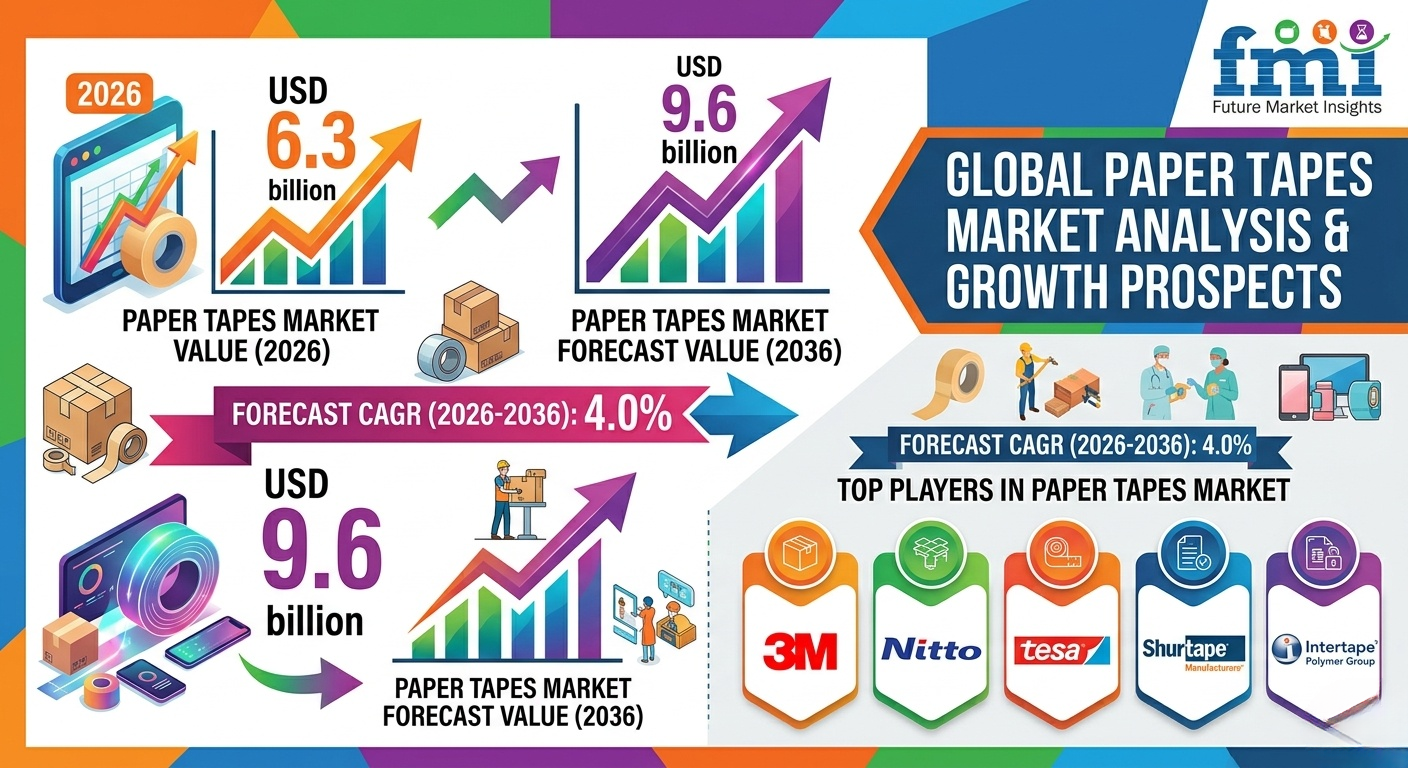
NEWARK, DE, UNITED STATES, March 26, 2026 /EINPresswire.com/ -- The global paper tapes market is entering a decade defined by packaging line efficiency, recyclability targets, and process integration across logistics and industrial packaging operations. Valued at USD 6.3 billion in 2026, the market is projected to reach USD 9.6 billion by 2036, expanding at a CAGR of 4.0%. The growth trajectory reflects increasing adoption of fiber-based sealing and masking solutions across e-commerce fulfillment, industrial packaging programs, and retail-ready packaging systems where recyclability and substrate compatibility influence material selection and packaging design standards.
According to long-term industry analysis, paper tapes are no longer treated as simple consumables but as critical components within packaging governance systems, where adhesion performance, tear behavior, unwind consistency, and recyclability compliance directly impact packaging line productivity, transport integrity, and sustainability reporting frameworks.
Discover Growth Opportunities in the Market – Get Your Sample Report Now
https://www.futuremarketinsights.com/reports/sample/rep-gb-10769
The Packaging Governance Shift: From Consumable to Controlled Packaging Component
The commercial structure of the paper tapes market is shaped by packaging specifications rather than spot purchasing decisions. Once a tape specification is approved for carton sealing, masking, bundling, or labeling applications, the same tape family often remains in use across multiple packaging lines and facilities for extended operational cycles. Changes to tape specifications typically require new line trials, seal integrity testing, and packaging validation procedures, making specification changes infrequent and strategically planned.
This dynamic means market growth is closely tied to the number of packaging programs converting from plastic tapes to paper-based tape systems. Competitive positioning therefore depends heavily on early involvement in packaging engineering, testing, and specification approval processes rather than purely on price competition.
Industry analysts note that packaging operations increasingly evaluate paper tapes through performance metrics such as adhesion to recycled corrugated board, tear resistance, humidity performance, and compatibility with automated dispensers. As packaging lines become faster and more automated, tape performance directly influences line efficiency, jam rates, and throughput consistency.
E-Commerce and Fulfillment Networks Drive Volume Expansion
One of the primary drivers of growth in the paper tapes market is the rapid expansion of e-commerce fulfillment networks and distribution centers. High-volume shipping operations require sealing solutions that integrate smoothly with automated case sealing equipment while maintaining consistent adhesion across varying temperature and humidity conditions.
Paper tapes are increasingly preferred in these environments because they align with recycling systems and fiber recovery processes, allowing companies to meet sustainability targets without compromising packaging performance. As companies standardize fiber-based packaging systems across logistics networks, paper tape adoption increases across multiple shipping categories and packaging formats.
Warehouse operations and packaging engineers are prioritizing sealing systems that maintain box integrity under stacking loads and transport compression while ensuring smooth application on high-speed packaging lines. These operational requirements are positioning paper tapes as both a closure solution and a process material critical to packaging line performance.
Segment Spotlight: Masking Tape and Rubber-Based Adhesives Lead Demand
Masking Tape Dominates Product Demand
Masking tape remains the largest product segment in the paper tapes market, accounting for approximately 46% of total market share. Its dominance is driven by widespread use in industrial painting, coating, finishing, and surface protection applications where clean removal, predictable peel strength, and residue control are critical.
Industrial users evaluate masking tapes based on removal behavior, edge bleed control, surface compatibility, and rework risk. Because surface damage and coating defects can create significant production losses, masking tape specifications are tightly controlled and rarely changed once approved.
Packaging tape follows masking tape in demand, driven by carton sealing and bundling applications in logistics and retail packaging operations. Consumer and stationery tapes represent smaller but stable segments used in office, retail, and general-purpose applications.
Rubber-Based Adhesives Anchor Adhesive Demand
Rubber-based adhesives account for approximately 58% of adhesive demand in the paper tapes market due to their high initial tack and reliable bonding across a wide range of surfaces. These adhesives support fast application speeds and consistent adhesion in high-volume production environments.
Acrylic-based adhesives are used in applications requiring better aging resistance and UV stability, while silicone-based adhesives are reserved for specialized applications involving extreme temperatures or low-surface-energy materials. However, rubber-based systems remain dominant due to their balance of adhesion strength, clean removal, and operational reliability.
Regional Growth Trends: Industrial Packaging Programs Shape Adoption
While the paper tapes market is global, growth patterns are strongly influenced by packaging automation levels, sustainability regulations, and industrial packaging program adoption in major manufacturing and logistics economies.
• United States (4.6% CAGR): The United States represents one of the fastest-growing markets for paper tapes, driven by e-commerce packaging expansion, logistics automation, and corporate sustainability initiatives. Packaging programs in large retail and logistics networks increasingly specify recyclable sealing materials, accelerating the transition from plastic tapes to paper tapes.
• United Kingdom (4.5% CAGR): In the United Kingdom, sustainability targets and packaging recyclability regulations are encouraging companies to adopt fiber-based packaging components, including paper tapes for sealing and bundling applications. High-speed packaging lines in retail and logistics sectors are supporting steady adoption.
• Japan (4.1% CAGR): Japan’s market growth is driven by industrial packaging and assembly operations where performance consistency, humidity resistance, and compatibility with automated application equipment are critical.
• South Korea (4.0% CAGR): South Korea is seeing steady growth due to manufacturing and logistics sectors prioritizing packaging materials compatible with automated and manual packaging lines.
• Brazil (3.9% CAGR): Brazil’s growth is driven by gradual adoption of sustainable packaging materials across retail, logistics, and industrial packaging operations.
Dynamics of the Decade: Recyclability, Automation, and Process Integration
Looking toward 2036, several major industry trends are expected to shape the competitive landscape of the paper tapes market:
• Fiber-Based Packaging Systems: Companies are increasingly standardizing fiber-based packaging systems to improve recyclability and reduce plastic packaging waste. Paper tapes play a central role in these packaging systems as recyclable closure solutions compatible with corrugated recycling streams.
• Automation Compatibility: Tape manufacturers are developing products designed specifically for automated dispensers, high-speed sealing equipment, and integrated packaging lines to reduce downtime and improve line efficiency.
• Application-Specific Tape Systems: Instead of generic tape products, manufacturers are developing application-specific tape families designed for particular carton grades, sealing speeds, and environmental conditions.
• Packaging Line Efficiency Metrics: Packaging operations are increasingly measuring tape performance through operational metrics such as jam rates, seal failure rates, throughput impact, and line downtime, making tape performance a process efficiency decision rather than a simple material cost decision.
Competitive Landscape: Performance Validation and Technical Support Define Market Position
The paper tapes market is highly competitive and technically driven, with suppliers competing through coating uniformity, adhesive performance, backing strength, and technical support during packaging validation and industrial line testing.
Key companies competing in the paper tapes market include:
• 3M Company
• Nitto Denko Corporation
• tesa SE
• Shurtape Technologies, LLC
• Intertape Polymer Group Inc.
Competition typically occurs during pilot production trials, coating validation, and packaging line testing. Once a tape product is approved and integrated into packaging programs, supplier relationships often continue for multiple years due to the complexity of changing packaging specifications.
Suppliers that can demonstrate consistent adhesion performance, reliable production quality, scalable manufacturing capacity, and technical integration support gain long-term supply agreements and stronger market positioning.
Industry experts note that competitive advantage increasingly comes from offering complete tape systems that reduce packaging line stoppages, shorten validation cycles, and maintain consistent sealing performance across multiple facilities and packaging formats.
Outlook: Packaging Standardization Will Define Market Growth
The long-term outlook for the paper tapes market is closely tied to packaging standardization, sustainability targets, and automation in logistics and industrial packaging operations. Growth is expected to come primarily from the conversion of packaging programs from plastic-based tapes to fiber-based sealing systems, expansion of e-commerce fulfillment networks, and increasing integration of packaging materials into automated production environments.
By 2036, paper tapes are expected to be firmly positioned not simply as packaging consumables, but as standardized components within packaging engineering systems, logistics automation infrastructure, and sustainability-driven packaging strategies. As packaging operations continue to prioritize recyclability, sealing reliability, and line efficiency, paper tapes will remain an essential material in modern packaging and distribution ecosystems.
Why FMI: https://www.futuremarketinsights.com/why-fmi
Explore More Research Reports by FMI
Cross Corner Industrial Bags Market - https://www.futuremarketinsights.com/reports/cross-corner-industrial-bags-market
Straw Market - https://www.futuremarketinsights.com/reports/straws-market
Labels Market - https://www.futuremarketinsights.com/reports/labels-market
Horizontal Form Fill Seal (HFFS) Machine Market - https://www.futuremarketinsights.com/reports/horizontal-form-fill-seal-machines-market
Rugged Cases Market - https://www.futuremarketinsights.com/reports/rugged-cases-market
About Future Market Insights (FMI)
Future Market Insights, Inc. (FMI) is an ESOMAR-certified, ISO 9001:2015 market research and consulting organization, trusted by Fortune 500 clients and global enterprises. With operations in the U.S., UK, India, and Dubai, FMI provides data-backed insights and strategic intelligence across 30+ industries and 1200 markets worldwide.
Sudip Saha
Future Market Insights Inc.
+1 347-918-3531
email us here
Legal Disclaimer:
EIN Presswire provides this news content "as is" without warranty of any kind. We do not accept any responsibility or liability for the accuracy, content, images, videos, licenses, completeness, legality, or reliability of the information contained in this article. If you have any complaints or copyright issues related to this article, kindly contact the author above.
