

Sustainable Fuel Market Volume to Worth 3.80 Million Tons by 2035
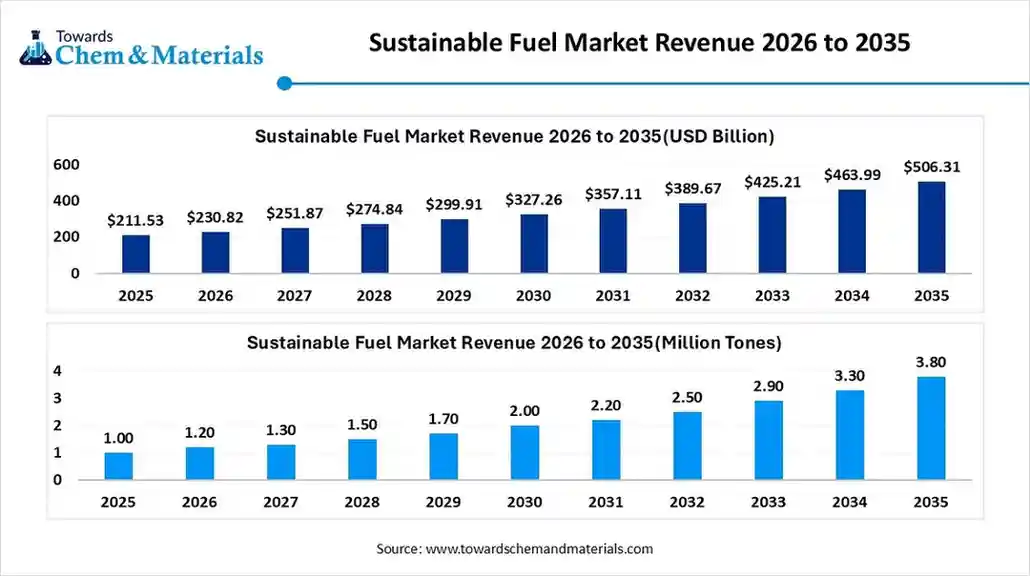
According to Towards Chemical and materials, the global sustainable fuel market volume was valued at 1 million tons in 2025 and is expected to be worth around 3.80 million tons by 2035, exhibiting at a compound annual growth rate (CAGR) of 14.12% over the forecast period from 2026 to 2035.
Ottawa, Jan. 06, 2026 (GLOBE NEWSWIRE) -- The global sustainable fuel market size was estimated at USD 211.53 billion in 2025 and is expected to increase from USD 230.82 billion in 2026 to USD 506.31 billion by 2035, growing at a CAGR of 9.12%. In terms of volume, the market is projected to grow from 1.00 million tons in 2025 to 3.80 million tons by 2035. exhibiting at a compound annual growth rate (CAGR) of 14.12% over the forecast period 2026 to 2035. The Asia Pacific dominated sustainable fuel market with the largest volume share of 35.91% in 2025.
Download a Sample Report Here@ https://www.towardschemandmaterials.com/download-sample/6115
The market is driven by strict government regulations, lowering the dependency on fossil fuels, reducing carbon emissions, and increasing consumer demand for sustainability.
The global sustainable fuel market is experiencing rapid growth as industries transition from fossil fuels to cleaner alternatives such as biofuels, green hydrogen, and synthetic e-fuels. This transition is propelled by stringent government policies, including mandatory blending requirements in the aviation and maritime sectors, as well as corporate commitments to achieve net-zero emissions.
Request Research Report Built Around Your Goals: sales@towardschemandmaterials.com
Sustainable Fuel Market Report Highlights
- By region, North America dominated the global sustainable fuel market with a volume share of 35.91% in 2025. Strong presence and demand fuel the growth of the market.
- By region, Asia Pacific is expected to have fastest growth in the market in the forecast period between 2026 and 2035. urbanization, and government-led clean energy initiatives fuel the growth of the market.
- By fuel type, the biofuels segment dominated the market with a volume share of 80% in 2025. Their compatibility makes it a preferred choice for the market.
- By fuel type, the hydrogen-based fuels segment is projected to grow at a CAGR between 2026 and 2035. Green hydrogen, produced using renewable electricity, is gaining traction for fuel cell vehicles and sustainable aviation fuel pathways.
- By technology, the hydro-processing segment dominated the market with a volume share of 58% in 2025. Its scalability and ability to utilize diverse feedstocks influence the adoption and growth.
- By technology, the electrochemical/synthetic segment is projected to grow at a CAGR between 2026 and 2035. gaining attention for long-haul aviation and shipping, where electrification is limited.
- By source, the crop-based segment dominated the market with a volume share of 52% in 2025. Strong agricultural output drives the growth.
- By source, the waste-based segment is projected to grow at a CAGR between 2026 and 2035. Renewable energy expansion fuels the growth of the market.
- By end-use, the road transportation segment dominated the market with a volume share of 68% in 2025. The sustainability initiatives drive the growth of the market.
- By end-use, the aviation segment is projected to grow at a CAGR between 2026 and 2035. Net-zero commitments, regulatory mandates further propel the growth.
Major Government Initiatives for the Sustainable Fuel Industry:
- European Union - RED III (Renewable Energy Directive): Enforceable as of May 2025, this directive mandates that 29% of transport energy come from renewables by 2030, with specific binding targets for advanced biofuels and renewable fuels of non-biological origin (RFNBOs).
- United States - Inflation Reduction Act (IRA): In 2025, the U.S. transitioned to the Section 45Z Clean Fuel Production Credit, a technology-neutral incentive offering up to $1.75 per gallon for domestic sustainable fuels based on their carbon intensity.
- India - Ethanol Blending Programme (EBP): India successfully achieved its nationwide target of 20% ethanol blending in petrol (E20) by late 2025, five years ahead of its original 2030 schedule.
- Brazil - RenovaBio (Fuels of the Future): This national policy mandates a steady increase in biodiesel blending, reaching 14% in 2025 and aiming for 20% by 2030, supported by tradable decarbonization credits (CBIOs).
- India - National Green Hydrogen Mission: This mission provides multi-billion-dollar incentives for green hydrogen and ammonia production, including specific pilot projects for hydrogen-fueled transport and bunkering facilities.
- United States - SAF Grand Challenge: A multi-agency federal effort aims to expand domestic SAF production to 3 billion gallons annually by 2030 and 35 billion gallons by 2050.
-
European Union - ReFuelEU Aviation: Starting in 2025, this regulation mandates that all aviation fuel supplied at EU airports contains at least 2% SAF, with the share increasing progressively through 2050.
Immediate Delivery Available | Buy This Premium Research Report@ https://www.towardschemandmaterials.com/checkout/6115
Sustainable Fuel Market Report Scope
| Report Attribute | Details |
| Market Size / volume in 2026 | USD 230.82 Billion / 1.20 Million Tons |
| Revenue forecast in 2033 | USD 506.31 Billion / 3.80 Million Tons |
| Growth rate | CAGR of 14.12% from 2026 to 2035 |
| Base year for estimation | 2025 |
| Historical data | 2018 - 2025 |
| Forecast period | 2026 - 2035 |
| Report coverage | Revenue forecast, company profiles, competitive landscape, growth factors, and trends |
| Segments covered | By Fuel Type, By Feedstock Source, By Process/Technology, By End-Use Application , By Regions |
| Region scope | North America; Europe; Asia Pacific; Latin America; Middle East & Africa |
| Key companies profiled | Neste Corporation, BP plc, Shell plc, TotalEnergies SE, Chevron Corporation, Eni S.p.A. , Valero Energy Corporation , World Energy , LanzaJet / LanzaTech , Gevo, Inc. , SkyNRG B.V. , Diamond Green Diesel , Marathon Petroleum Corporation , Phillips 66 , Aemetis, Inc. , Prometheus Fuels , HIF Global , Air Liquide , Topsoe (Haldor Topsoe) , Sunfire GmbH |
For more information, visit the Towards Chemical and Materials website or email the team at sales@towardschemandmaterials.com| +1 804 441 9344
What are the different types of sustainable fuels?
Sustainable fuels include the following:
-
Conventional biomass-based fuels are produced from organic matter, including food crops. These fuels are typically blended with small amounts of conventional fossil fuels.
Ethanol is a well-known conventional biofuel. First-generation ethanol is made from corn, while second-generation ethanol is produced from residues such as bagasse, a byproduct of sugarcane processing. Ethanol is used primarily in gasoline blends.
Other biofuels include fatty acid methyl ester (FAME), a type of biodiesel derived from either vegetable oils or animal fats. Biomethanol is produced from agricultural residues, woody biomass, or byproducts from pulp mills. And biogas is produced through the anaerobic digestion of waste streams such as manure, food waste, or wastewater.
- Drop-in sustainable fuels can be used in existing, conventional internal combustion engines (ICE). These can be produced from either edible or residue biomass sources by using low-carbon hydrogen or by synthesizing sustainable captured carbon and low-carbon hydrogen. Drop-in fuels have already been used as replacements for diesel, jet fuel, and natural gas.
- Non-drop-in e-fuels or hydrogen-based fuels are manufactured by using captured carbon and hydrogen from low-carbon electricity sources (such as renewable or nuclear energy). Low-carbon hydrogen produced through electrolysis is also sometimes known as liquid hydrogen or gaseous hydrogen. When hydrogen is combined with acceptable sources of carbon, it can form e-fuels such as e-methanol or e-ammonia.
How can existing petroleum refineries be converted to produce sustainable fuels?
Petroleum refineries around the world are under pressure to ramp up sustainable-fuel production from a range of factors, such as changing market conditions, evolving environmental regulations, and higher costs. In response, leaders in the petroleum industry are looking to convert existing refineries to produce sustainable fuels such as renewable diesel and sustainable aviation fuel. This kind of conversion can be faster and more cost effective than constructing brand-new production facilities for renewable fuel.
The major considerations for converting existing refineries include the availability of feedstock and the plant’s current configuration and production capacity. Refineries that are close to big cities will have access to a steady supply of used cooking oil, for example, whereas those close to ethanol production facilities will have access to soybean oil or distillers corn oil. Government incentives to make these changes vary by region, as does market demand.
What Are the Major Trends in the Sustainable Fuel Market?
- Regulatory Mandates: Governments and international organizations, including the IMO and ICAO, are intensifying regulations and blending mandates to mitigate greenhouse gas emissions. This regulatory clarity fosters increased investment and adoption within the aviation and maritime industries.
- Scaling of Sustainable Aviation Fuel (SAF): SAF has achieved commercial advancement, with global production projected to double. Significant airline commitments and refinery expansions.
- Expansion of Synthetic E-Fuels: E-fuels, produced by integrating green hydrogen with captured CO2, represent the fastest-growing segment of this technology. Although presently costly, they offer the potential for an unlimited, net-zero carbon supply compatible with existing internal combustion engines.
- Innovation and Digitalization: Innovation led the product development and optimized the solution, while digital integration involves smart systems, especially in automation.
- Decarbonization of Maritime and Heavy Industry: The adoption of sustainable fuels in shipping is increasing in response to increasingly stringent IMO regulations and the global shift toward a carbon neutrality target.
- Commitments and Strategic Collaborations: Airlines, shippers, and fuel producers are establishing strategic partnerships and long-term supply agreements aimed at meeting ambitious net-zero and ESG objectives, thereby reducing investment risks and reinforcing supply networks.
Immediate Delivery Available | Buy This Premium Research Report@ https://www.towardschemandmaterials.com/checkout/6115
Is Technological Shift Driving the Sustainable Fuel Market?
Technological innovations, driven by AI and digital technologies, are optimizing the entire value chain from feedstock sourcing to distribution, significantly improving efficiency, reducing costs, and boosting sustainability and transparency. These shifts focus on moving beyond traditional biofuels to advanced, scalable, and low-carbon solutions, mainly advanced biofuels and e-fuels, with AI and machine learning optimizing complex logistics in the sustainable fuel supply chain.
Market Opportunity
Will the competitive landscape in the sustainable fuel industry drive future market growth?
Companies are focusing on enhancing conversion efficiencies, exploring new feedstocks, and developing new fuel standards to ensure quality and safety. Policy measures, subsidies, and carbon pricing are expected to influence competition, and firms are aligned with regulations. Collaborations among technology providers, feedstock suppliers, and end-user industries are fostering innovation and market growth. The rise of green finance and dedicated investment funds for renewable energy projects also enhances growth prospects.
Sustainable Fuel Market Segmentation Insights
Product Type Insights
How Biofuel Segment Dominate the Sustainable Fuel Market in 2025?
The biofuels segment is projected to hold the largest market share in 2025. Particularly driven by growing environmental concern, limited availability of fossil fuel-based resources, rising awareness regarding the reduction of carbon emissions, and demand for renewable fuel. Government policies and incentives to reduce greenhouse gas emissions are driving the biofuel adoption. The key application is in transportation and increasing programs in the aviation and marine sector, powering the market of biofuels.
The hydrogen-based fuels segment is anticipated to grow fastest as demand rises for the zero-emission combustion capability. Driven by the need for decarbonization and the global shift towards carbon neutrality. Globally, governments are reinforcing stringent regulations and financial incentives to accelerate the adoption of hydrogen technologies. In many industrial processes like the production of steel, ammonia, fuel cells in EVs, refining, and internal combustion engines, hydrogen is a key source that offers a clean alternative to reduce carbon footprint. The investment in hydrogen projects is increasing in various countries to develop hydrogen infrastructure and zero-emission commitments, which facilitate hydrogen market expansion.
Technology Insights
Which Technology Segment Held the Dominating Share of the Sustainable Fuel Market in 2025?
The hydro-processing segment dominated the market, supported by widespread commercial technology for creating drop-in sustainable fuels and versatile feedstocks, fueling the shift toward cleaner fuels and improved refinery processes. It plays a crucial role in converting biomass into renewable diesel and jet fuel, enabling compatibility with existing refinery infrastructure while offering high-performing fuels that ensure long-term sustainability.
The electrochemical/synthetic segment is set to experience the fastest growth, especially for e-fuels (synthetic fuels), driven by the aviation sector's demand for sustainable aviation fuel and advances in green hydrogen production through electrolysis. This allows scalable, carbon-neutral fuel synthesis using renewable electricity. These technologies involve transforming captured CO₂ and green hydrogen into liquid fuels via advanced catalytic and power-to-liquid processes.
Source Insights
How did the Crop-Based Segment hold the Largest Share of the Sustainable Fuel Market?
The crop-based segment dominated the market, primarily through first-generation biofuels like ethanol and biodiesel. This leadership is supported by mature agricultural supply chains and mandates in the road transportation sector. However, sustainability concerns related to land use and food security are encouraging innovation toward higher yields and alternative non-food crop solutions.
The waste-based segment is expected to grow at the fastest CAGR during the projected period, driven by rapid urbanization, landfilling, and industrialization. The large amount of municipal solid waste and household waste helps to generate fuel by using the processes of gasification, pyrolysis. The increasing demand for innovations in waste management technologies enhances sustainability, and waste-to-fuel technology promotes a market by reducing landfill use and greenhouse gas emissions. Major oil and energy sectors are implementing waste-to-fuel technology to promote the long-term growth of the market.
End-User Insights
Which End-User Segment Leads the Sustainable Fuel Market?
The road transportation segment led the market, characterized by growing dependence on biofuels, hydrogen fuel technologies, and electric vehicles, driving this application. The government initiatives and regulations for emission shifting towards cleaner and sustainable fuel for vehicles and logistics, enhancing the market demand for ethanol, biodiesel. The investment and innovation in hydrogen biofuel and renewable natural gas (RNG) have the potential to reduce emissions, which is crucial in transitioning to sustainable transportation.
The aviation segment is expected to grow at the fastest CAGR over the forecast period. The technological advancement, groundbreaking SAF development, and innovation are decreasing manufacturing costs and increasing performance. and increasing programs in the aviation and marine sector, powering the market of biofuels.
Regional Insights
How did North America dominate the Sustainable Fuel Market?
The North America sustainable fuel market was estimated to be USD 99.72 billion in 2025 and is projected to reach USD 238.93 billion by 2035, at a CAGR of 9.14% during the forecast period. By volume, the market is projected to grow from 0.46 million tons in 2026 to 1.57million tons in 2035. growing at a CAGR of 13.57% from 2026 to 2035.
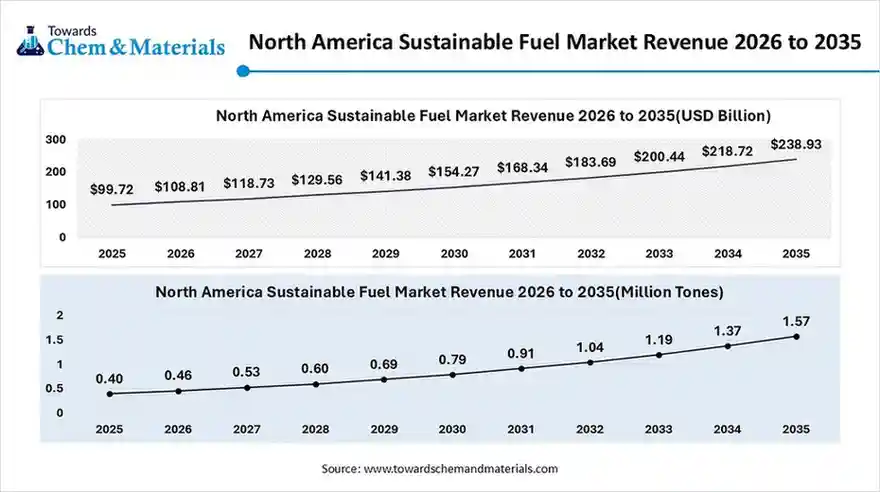
North America has been leading the market due to urbanization, the enforcement of stringent pollution control regulations, and a growing population. The primary focus is to reduce greenhouse gas emissions and minimize the carbon footprint. The region shows high implementation of biofuels, sustainable aviation fuel (SAF), and green hydrogen. The rising investment in renewable energy technologies is promoting innovation for sustainable alternatives and low-carbon fuel solutions for several application sectors like aviation, energy, and logistics.
U.S. Sustainable Fuel Market Trends:
The significant investment in R&D infrastructure to enhance fuel efficiency and government policies and incentives to encourage the production and consumption of advanced fuels are driving this region's growth. The U.S. is leading in ethanol, biodiesel production under the Renewable Fuel Standard (RFS). The United States is a key player in sustainable fuel projects and the transportation sector for mandating renewable fuels.
Why is the Asia Pacific the Fastest-Growing Region in the Sustainable Fuel Industry?
Asia-Pacific is expected to grow at the fastest CAGR from 2026 to 2035 due to rapid industrialization, urbanization, and increasing biofuel adoption. The government initiatives and regulations focus on reducing dependence on fossil fuels, and subsidies are a significant driver of market expansion. The need for energy security has led to accelerated demand for biofuels in this region. The increasing concern about climate change emphasizes the necessity for cleaner energy sources and setting emission reduction targets.
India Sustainable Fuel Market Trends:
The India market is the leading global SAF producer in the Asia-Pacific driven by strong aviation growth, agricultural waste feedstock, and strong government support. India is rapidly moving towards cleaner fuel that pushing for domestic biofuel self-sufficiency.
More Insights in Towards Chemical and Materials:
- Sustainable Paper Chemicals Market Size to Hit USD 62.12 Billion by 2035
- Sustainable Aviation Fuel (SAF) Market Size to Surge USD 357.41 Bn by 2035
- Sustainable Catalysts Market Size to Surpass USD 16.54 Bn by 2035
- Sustainable Materials Market Size to Hit USD 1,078.35 Bn by 2034
- Asia Pacific Sustainable Chemicals Market Size to Surge USD 59.74 Bn by 2034
- U.S. Sustainable Chemicals Market Size to Hit USD 30.59 Billion by 2034
- Sustainable Plastics Market Size to Hit USD 1,448.23 Bn by 2034
- Sustainable EPDM Market Volume to Reach 2,61,364.2 Tons by 2034
- Construction Chemicals Market Size to Reach USD 72.7 Billion by 2034
- Lubricants Market Size to Reach USD 211.53 Billion by 2034
- Propylene Glycol Market Size to Hit USD 9.61 Billion by 2034
- Sustainable Adhesive Market Leads USD 4.19 Bn at 5.4% CAGR
- Sustainable Construction Material Market Size to Surpass USD 483.73 Bn by 2025
- Very Low Sulphur Fuel Oil Market Size to Hit USD 550.45 Bn by 2035
- Aviation Fuel Market Size to Hit USD 841.99 Billion by 2035
- Ammonia Fuel Market Size to Surpass USD 4,831.23 Mn by 2035
- U.S. Biofuels Market Size to Surpass USD 109.65 Billion by 2035
- Biofuels Market Size to Reach USD 326.99 Billion by 2035
- Advanced Biofuels Market Size to Surpass USD 3,004.03 Bn by 2035
- Asia Pacific Biofuels Market Size to Surge USD 70.22 Billion by 2034
- Specialty Fuel Additives Market Size to Hit USD 22.4 Billion by 2034
- Petroleum Fuel Dyes and Markers Market Size to Reach USD 908.32 Bn by 2034
Recent Breakthrough in the Sustainable Fuel Industry
- In November 2024, TotalEnergies and SINOPEC signed a strategic partnership agreement to establish a sustainable aviation fuel (SAF) production unit. This collaboration is front-foot in reducing aviation's carbon footprint, aligned with circular economy principles.
- In March 2024, Gasum and the Norwegian Road Transport Association (NLF) signed a collaboration agreement to promote biogas as an alternative to fossil fuels for Norway's green transition. emphasizing its role in reducing greenhouse gas emissions in heavy-duty transport.
Sustainable Fuel Market Top Key Companies:
- Neste Corporation
- BP plc
- Shell plc
- TotalEnergies SE
- Chevron Corporation
- Eni S.p.A.
- Valero Energy Corporation
- World Energy
- LanzaJet / LanzaTech
- Gevo, Inc.
- SkyNRG B.V.
- Diamond Green Diesel
- Marathon Petroleum Corporation
- Phillips 66
- Aemetis, Inc.
- Prometheus Fuels
- HIF Global
- Air Liquide
- Topsoe (Haldor Topsoe)
- Sunfire GmbH
Sustainable Fuel Market Report Segmentation
This report forecasts revenue growth at global, regional, and country levels and provides an analysis of the latest industry trends in each of the sub-segments from 2019 to 2035. For this study, Towards Chemical and Materials has segmented the global Sustainable Fuel Market
By Product Type
- Biofuels (Liquid & Gaseous)
- Renewable Diesel (HVO - Hydrotreated Vegetable Oil)
- Sustainable Aviation Fuel (SAF)
- Bio-Ethanol (1G and 2G)
- Bio-Methanol
- Renewable Natural Gas (RNG) / Biomethane
- Hydrogen-Based Fuels (Green & Blue)
- Green Hydrogen (Electrolysis)
- Blue Hydrogen (SMR with Carbon Capture)
- Liquid Hydrogen for Mobility
- Synthetic Fuels (E-Fuels / Power-to-Liquid)
- E-Kerosene (Synthetic SAF)
- E-Diesel
- E-Methanol (Marine)
- E-Ammonia (Marine/Industrial)
By Feedstock Source
- Waste-Based (Second Generation)
- Used Cooking Oil (UCO) and Animal Fats (Tallow)
- Municipal Solid Waste (MSW)
- Agricultural Residues (Corn Stover, Straw)
- Forestry Residues and Wood Waste
- Crop-Based (First Generation)
- Sugar-Based (Sugarcane, Sugar Beet)
- Starch-Based (Corn, Wheat)
- Vegetable Oils (Soybean, Rapeseed, Palm)
- Gaseous & Non-Biological Sources
- Captured Carbon Dioxide ($CO_2$)
- Industrial Waste Gases (Flue gas)
- Renewable Electricity (Wind/Solar for Electrolysis)
By Process/Technology
- Thermochemical Conversion
- Gasification and Fischer-Tropsch (FT) Synthesis
- Pyrolysis (Fast and Slow)
- Hydrothermal Liquefaction (HTL)
- Biochemical Conversion
- Anaerobic Digestion (Biogas)
- Fermentation (Ethanol/Butanol)
- Electrochemical/Synthetic (Power-to-X)
- Water Electrolysis (PEM, Alkaline, SOEC)
- Carbon Capture and Utilization (CCU)
- Hydro-Processing
- Hydroprocessed Esters and Fatty Acids (HEFA)
- Alcohol-to-Jet (AtJ)
By End-Use Application
- Aviation
- Commercial Airlines
- Military & Defense Aviation
- Business and General Aviation
- Maritime & Shipping
- International Ocean Freight
- Inland Waterway Transport
- Road Transportation
- Heavy-Duty Trucking (Long-Haul)
- Public Transit (Buses/Rail)
- Passenger Vehicles (Hybrid/Biofuel Blends)
- Industrial & Power
- Industrial Heating/Boilers
- Stationary Power Generation
By Regional
- North America
- Europe
- Asia Pacific
- Latin America
- Middle East & Africa
Immediate Delivery Available | Buy This Premium Research Report@ https://www.towardschemandmaterials.com/checkout/6115
About Us
Towards Chemical and Materials is a leading global consulting firm specializing in providing comprehensive and strategic research solutions across the chemical and materials industries. With a highly skilled and experienced consultant team, we offer a wide range of services designed to empower businesses with valuable insights and actionable recommendations.
Our Trusted Data Partners
Towards chem and Material | Precedence Research | Towards Packaging | Towards Healthcare | Towards Food and Beverages | Towards Automotive | | Nova One Advisor | Nutraceuticals Func Foods | Onco Quant | Sustainability Quant | Specialty Chemicals Analytics | TCM Blog
For Latest Update Follow Us: https://www.linkedin.com/company/towards-chem-and-materials/
USA: +1 804 441 9344
APAC: +61 485 981 310 or +91 87933 22019
Europe: +44 7383 092 044
Email: sales@towardschemandmaterials.com
Web: https://www.towardschemandmaterials.com/


Legal Disclaimer:
EIN Presswire provides this news content "as is" without warranty of any kind. We do not accept any responsibility or liability for the accuracy, content, images, videos, licenses, completeness, legality, or reliability of the information contained in this article. If you have any complaints or copyright issues related to this article, kindly contact the author above.
